Doi Inthanon National Park has seven named waterfalls, and no two of them behave the same way. Wachirathan roars right off the roadside; Mae Pan drops a clean 100 meters through the forest and barely sees a visitor. The park climbs from lowland river valleys up to Thailand's highest point at 2,565 meters, so the falls sit far apart, at different elevations, with different rules on swimming and access. This guide covers all seven: what to expect at each, what it costs, when to go, and how to string them into one route without wasted driving.
Doi Inthanon Waterfalls at a Glance
Six of the seven falls are quick stops off the main park road; the seventh, Mae Pan, takes real effort to reach. Here's how the six most-visited compare before you plan a route.
| Waterfall | Height | Walk from parking | Swimming | Crowd level |
|---|---|---|---|---|
| Mae Ya | 40-50m tier (260-280m full drop) | 10-15 min, flat | Partial, seasonal | Moderate |
| Wachirathan | ~40m (locally cited up to 80m) | 1-2 min | No | High |
| Mae Klang | ~100m over several tiers | 2-5 min | Yes | High |
| Sirithan | Viewpoint only | ~10 min via steps | No | Low-moderate |
| Siriphum | Forest trail falls | ~30 min (1.5km) | No | Low |
| Pha Dok Siew | On guided nature trail | 2.6km guided walk | No | Low |
Mae Pan, the seventh, doesn't fit neatly into that table. It's the park's tallest single, uninterrupted drop at around 100 meters, but it sits down a 2km dirt track off the Mae Chaem road in the remote southwest corner and sees a fraction of the traffic the others do. Mae Ya is an outlier for logistics too: it sits outside the main park gate in the southern section, with its own checkpoint, though the same ticket covers it. Short on time? Wachirathan, Mae Klang and Mae Ya cover the range from roadside power to full-height spectacle, and all three are reachable without an early start or a guide. For the park's other highlights, from the summit boardwalk to the Two Chedis, see our Doi Inthanon overview.
The 7 Waterfalls of Doi Inthanon, One by One
Numbered here in the order most itineraries hit them, with Mae Ya and Mae Pan as the two outliers at opposite ends of the effort scale.
1. Mae Ya Waterfall
Mae Ya is the one most people picture when someone says Doi Inthanon waterfalls. The visible tier drops roughly 40-50 meters over a curtain about 100 meters wide, and the full cascade above it is said to fall close to 260-280 meters across tiers hidden further upstream. It sits outside the main park gate, in the southern section, reached by a flat 10-15 minute walk from the car park. Part of the pool at the base can be calm enough for a swim depending on the season and water level, so check with rangers on site before getting in.
Photographers get here right after sunrise, when the light sits flat and even across the whole rock face. Midday sun blows out the highlights on the pale limestone. There's no food stall at this entrance, just parking and a short path, so eat before you arrive if you're making it your first stop.
2. Wachirathan Waterfall
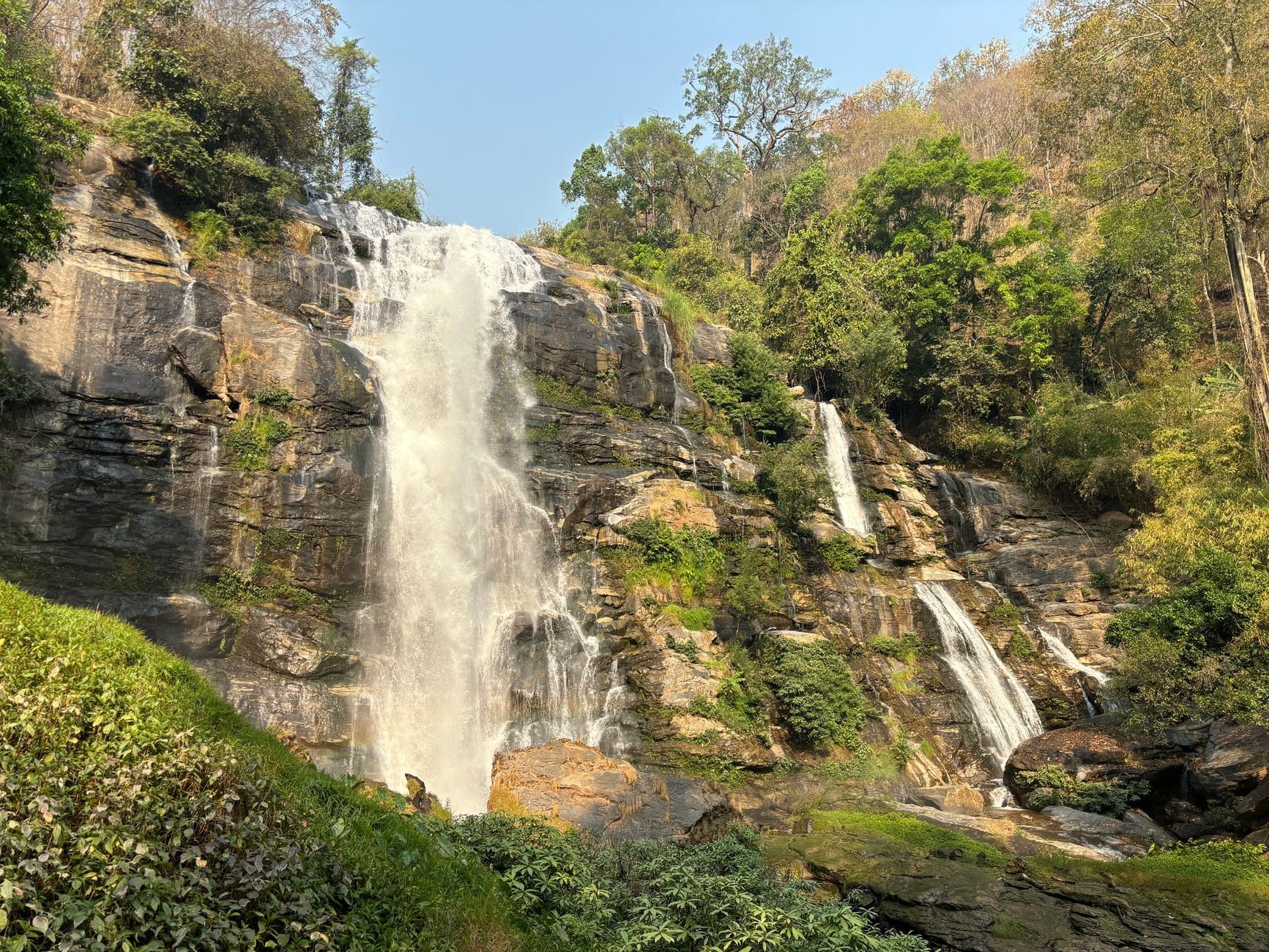
Wachirathan is the loud one. It sits right off the summit road, a 1-2 minute walk from the car park, and throws up enough spray that the viewing platform gets genuinely wet on a windy day. The park's own description puts it at about 40 meters tall, though guides often call it 80m, likely counting a longer run of cascades above the main drop. Swimming isn't allowed here; the rock is slick and the current at the base is stronger than it looks.
A small cluster of food vendors sits near the parking area, useful if you're stopping mid-route rather than first thing. Every tour bus treats this as a five-minute photo stop, so come right at opening, or later in the afternoon, if you want it without a crowd.
3. Mae Klang Waterfall
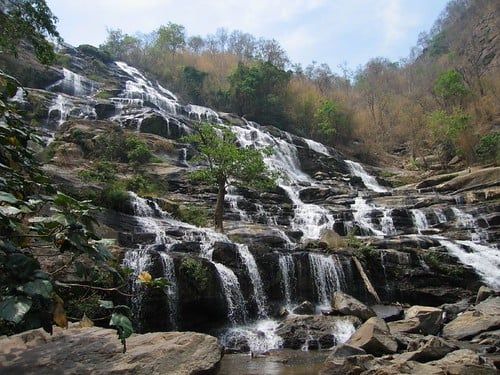
Mae Klang is the first fall most visitors reach, about 600 meters south of the main checkpoint, and it's the easiest of the seven to visit. Flat paths lead from a car park with food stalls and toilets. The water drops close to 100 meters across several tiers, with the tallest single tier around 25-30 meters. Some of the lower pools are calm enough for swimming, making this the one fall in the park where families can actually get in the water. Expect it busy — it's the closest fall to the entrance, and every tour stops here.
4. Sirithan Waterfall
Sirithan is a viewpoint, not a swim spot. A boardwalk and roughly 100 wooden steps lead to a platform looking across the falls; there's no path down to the base. It draws a fraction of the crowd that Wachirathan and Mae Klang do, which makes it a good stop for five quiet minutes rather than a photo shared with a tour bus.
5. Siriphum Waterfall
Siriphum sits near park headquarters and Ban Khun Klang village, reached by a forest trail of about 1.5 kilometers that climbs gently and stays noticeably cooler than the lowland falls. Time it for late January or early February and the surrounding hillside fills with the pink-white blossom of Siamese sakura, a wild Himalayan cherry — one of the only places in Thailand with anything close to a cherry blossom season.
6. Pha Dok Siew Waterfall
Pha Dok Siew sits halfway along a nature trail of about 2.6 kilometers that also runs through the Karen village of Baan Mae Klang Luang and its rice terraces. Round-trip distance is sometimes quoted closer to 5.3 kilometers depending on where the count starts, so budget half a day rather than an hour. It's the one fall you can't just walk to: the trail requires a local guide, arranged on site for 220 Baht per group of up to 10 people. That fee buys more than the waterfall — guides point out crops, village life and the terrace system along the way, making this the most immersive stop of the seven, if also the slowest.
7. Mae Pan Waterfall
Mae Pan drops in a single, uninterrupted sheet of about 100 meters, the tallest one-tier fall in the park. Getting there means turning off the Mae Chaem road onto a 2km dirt track in the remote southwest corner, which keeps the crowds away almost entirely. A small campsite sits nearby for anyone who wants to base here rather than day-trip it. If you've already seen Mae Ya and Wachirathan and want something that feels undiscovered, this is the one worth the detour.
Entrance Fees, Hours & Practical Logistics
A national park ticket costs 300 Baht for foreign adults and 150 Baht for foreign children aged 3-14; Thai nationals pay 60 Baht and 30 Baht. Add a vehicle fee of 30 Baht for a car or 20 Baht for a motorbike. These figures date to June 2022, so confirm current entry fees and hours before you go, since gate staff won't always have change for large notes.
One ticket, valid for 5 days, covers every waterfall in the park, including Mae Ya's separate checkpoint outside the main gate. That's worth knowing if you're staying nearby and want to spread the seven falls across two visits instead of rushing them into one long day.
The park itself opens somewhere between 5:30am and 6:30am and closes between 4:30pm and 6:30pm, depending on the season and gate; the visitor center at headquarters keeps stricter 8am-4pm hours. Arrive at opening if you want Wachirathan or Mae Klang without a tour bus already parked in front of them.
Best Time to Visit the Waterfalls
Rainy season, roughly May or June through October or November, pushes every waterfall to its fullest. Wachirathan turns into a wall of noise and spray, and Mae Ya's curtain widens across the whole rock face. The tradeoff is muddy trails and the occasional closure after heavy storms, particularly on routes like Pha Dok Siew and Mae Pan's access road.
Dry season, November through February, suits most visitors better. Water still runs strong through December and thins out by February, but the trails firm up and the water itself photographs cleaner. November through January is the real sweet spot: flow stays close to peak from the tail of the rains while skies stay clear.
Skip March and April if you can. Burning season blankets the region in haze from agricultural fires, dulling both the views and the air. If cherry blossoms matter to you, late January to early February is the only window — that's when Siamese sakura bloom around Siriphum and the nearby Royal Project grounds.
Getting There, Getting Around & a One-Day Waterfall Route
The main checkpoint sits at km8 on Road 1009, off Highway 108, about 70 kilometers southwest of Chiang Mai — figure on 1.5 to 2 hours by car. Park headquarters, where the Siriphum trail starts, is another 22 kilometers up the mountain. Getting to the park is straightforward by road; getting between its attractions once you're inside is the part people underestimate.
Self-driving or hiring a private driver is the only practical way to see more than one or two falls in a day. A private taxi for a full day runs from around 3,200 Baht. Public songthaews exist but require transfers, usually via Chom Thong, and can take 2.5 to 3 hours or more one-way — workable if you only want Mae Klang or Wachirathan, painful if you want all seven. A day tour from Chiang Mai or a private tour solves the transport and route-planning problem in one booking.
Drive times between the falls run 20 to 40 minutes depending on the pair, so a one-day, all-seven itinerary means an early start and no long lunches. A workable order: Mae Ya first, before 8am, while the parking lot is empty — a guided sunrise tour handles that early start without you driving in the dark. Follow with Mae Klang, Wachirathan and Sirithan, all bunched near the main road, then head up to Siriphum near headquarters. Pha Dok Siew's guided trail and Mae Pan's dirt-road detour each eat 2-3 hours, so most people save one or both for a second day. Anyone chasing the fuller route should look at a dedicated hiking tour that builds in guide fees and transfer time.
Swimming Rules, Safety & What to Pack
Mae Klang is the park's one reliable swimming spot, with calm lower pools that hold up through most of the year. Mae Ya allows a partial swim depending on season and water level, but check conditions on site before getting in. Wachirathan and Sirithan don't allow swimming at all, and for good reason: the rock at both is smooth, wet and steep, without anything resembling a proper pool at the base. Most of the park's other falls sit on similar rocky terrain, so even where there's no explicit ban, there's rarely anywhere safe to swim.
- Grippy shoes or sandals — wet rock is slicker than it looks
- Cash, since there are no ATMs inside the park
- A light rain layer or poncho for Wachirathan's spray
- Insect repellent, especially on forested trails like Siriphum
- A few hundred extra Baht for the Pha Dok Siew guide fee
Drones are allowed with a Thai drone permit, arranged in advance rather than at the gate. Open, wide falls like Mae Ya and Mae Klang give the easiest flying conditions; Wachirathan's narrow gorge and spray make it trickier, and flying over Pha Dok Siew's village trail needs extra care around people and livestock.
FAQs
How many waterfalls are there in Doi Inthanon National Park?
Seven are named and signposted: Mae Ya, Wachirathan, Mae Klang, Sirithan, Siriphum, Pha Dok Siew and Mae Pan. Some sources round up to '10+' if you count minor, unnamed cascades along the trails.
Can you swim in the waterfalls at Doi Inthanon?
Yes, at Mae Klang, and partially at Mae Ya depending on the season. Wachirathan, Sirithan and most of the others prohibit or simply don't offer safe swimming due to rocky terrain.
Which is the most beautiful waterfall in Doi Inthanon?
Mae Ya is the most cited for scale and photogenic width. Wachirathan is the more popular quick stop, better suited to a short visit if you're not driving south to Mae Ya.
Do you need a guide to visit the waterfalls?
No, except at Pha Dok Siew, where a local guide is required as part of the nature trail (220 Baht per group of up to 10). Mae Ya, Wachirathan, Mae Klang, Sirithan, Siriphum and Mae Pan can all be visited on your own.
Is one day enough to see all the Doi Inthanon waterfalls?
With your own car and an early start, you can comfortably see four or five of the closer falls. Fitting in all seven, including the remote Mae Pan and the guided Pha Dok Siew trail, is easier over a day and a half.
Do I need to pay separately to enter Mae Ya Waterfall?
No. Mae Ya has its own checkpoint outside the main park gate, but the standard national park ticket, valid 5 days, covers it along with every other waterfall.
What is the best time of year to see the waterfalls at their most powerful?
Rainy season, roughly May or June through October or November, produces the strongest flow. November through January balances strong flow with clear skies and easier trails.
How do you get between the waterfalls without a tour?
Self-driving or hiring a private driver for the day works best, since the falls sit 20-40 minutes apart. Public songthaews are slow and need transfers, usually through Chom Thong.